
What Is ALM Training? The Complete Guide to Appointment, Location & Motivation
Every salesperson has heard the advice:
"Build rapport."
"Ask better questions."
"Don't sound scripted."
But what does that actually look like during a real conversation?
That's where ALM Training comes in.
ALM is one of the simplest—and most effective—conversation frameworks for qualifying leads without sounding like you're interrogating them. Rather than focusing on clever closing techniques or memorized scripts, ALM teaches sales professionals to understand three critical things before making recommendations:
Appointment
Location
Motivation
Originally popularized within Zillow Premier Agent training, the ALM framework has become a proven approach for guiding conversations with home buyers and sellers. Although it originated in real estate, its principles apply to almost every consultative sales industry, from insurance and mortgages to solar, automotive, financial services, and SaaS.
In this guide, you'll learn:
What ALM Training is
What Appointment, Location, and Motivation actually mean
Why this framework works
Research-backed insights into buyer and seller behavior
Common mistakes agents make
The fastest way to practice ALM conversations
What Does ALM Mean?
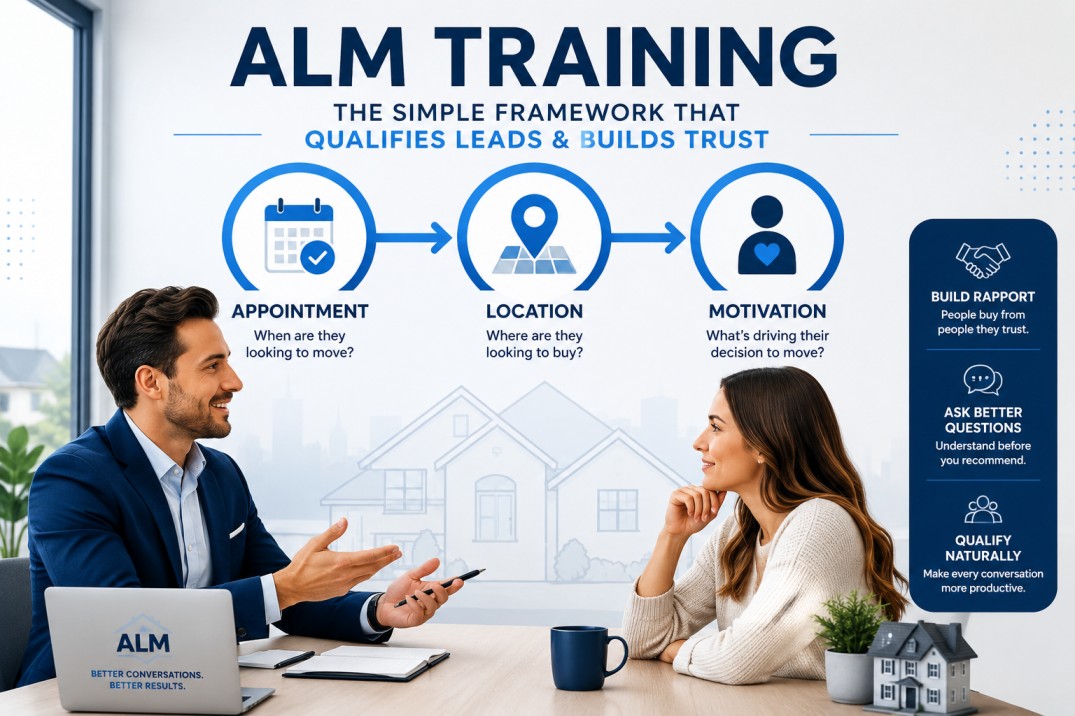
ALM stands for:
A — Appointment
L — Location
M — Motivation
Think of ALM as a conversation roadmap—not a script.
Many new agents believe successful sales conversations come from saying exactly the right words.
Experienced professionals know the opposite is true.
The best conversations happen because the salesperson asks thoughtful questions, listens carefully, and understands what truly matters before offering solutions.
That is exactly what ALM encourages.
Instead of trying to "sell," you're trying to discover.
Why Zillow Uses the ALM Framework
One reason ALM has gained popularity is that Zillow teaches it to Premier Agents as part of their lead conversion strategy.
Rather than immediately pitching homes or discussing prices, Zillow encourages agents to structure conversations around:
Setting or working toward an appointment
Understanding where buyers want to live
Discovering why they're moving in the first place
This order creates more natural conversations and helps agents qualify leads much faster.
The framework also aligns with modern consumer behavior.
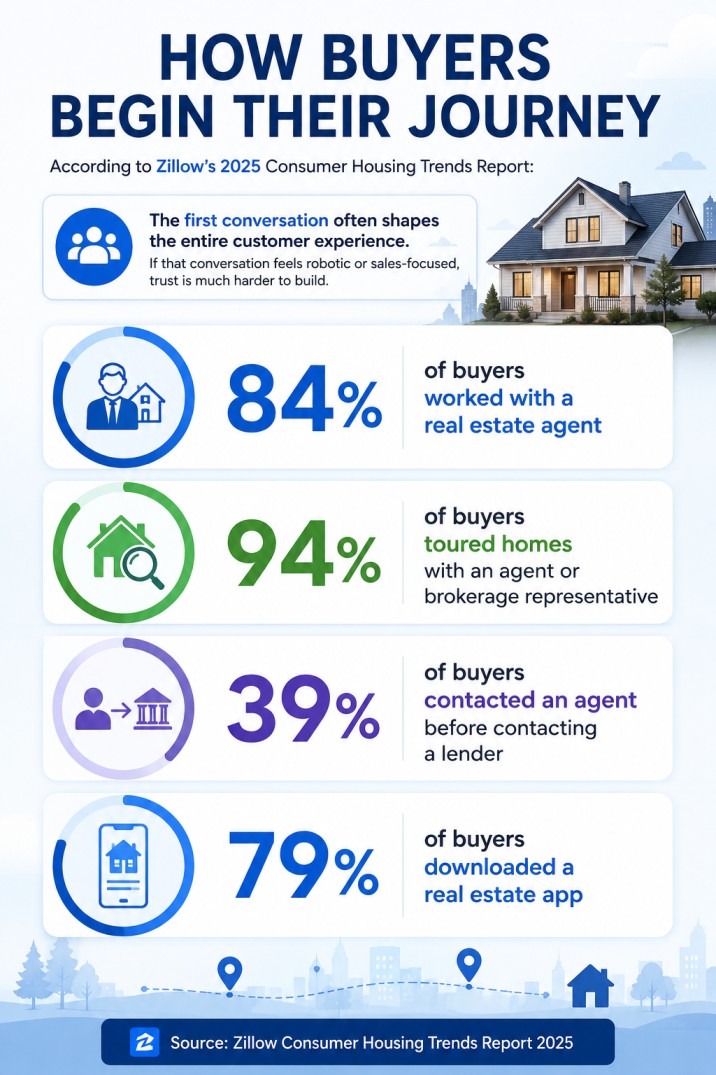
According to Zillow's 2025 Consumer Housing Trends Report:
84% of buyers worked with a real estate agent
94% toured homes with an agent or brokerage representative
39% contacted an agent before contacting a lender
79% downloaded a real estate app during their home search
These numbers highlight something important:
The first conversation often shapes the entire customer experience.
If that conversation feels robotic or sales-focused, trust is much harder to build.
Source: Zillow Consumer Housing Trends Report.
Appointment
What the Appointment Really Means
Many beginners think the goal is simply getting a meeting on the calendar.
That's only part of the story.
A successful appointment is the natural outcome of a conversation where the prospect feels understood and believes continuing the discussion will help them reach their goals.
In other words:
Appointments are earned—not forced.
Common Appointment Mistakes
Many agents unintentionally reduce their appointment rates by:
Asking for an appointment within the first minute
Following a rigid script
Ignoring what the prospect is actually saying
Treating every lead identically
Rushing toward the sale
People don't like being sold.
They do enjoy talking with someone who genuinely wants to understand them.
Better Appointment Examples
Instead of:
"Can I schedule you for tomorrow?"
Try:
"It sounds like you've already been thinking about this for a while. It might be helpful if we spent twenty minutes looking at your options together."
Or:
"Would sometime later this week work to walk through a few possibilities?"
The language feels collaborative rather than transactional.
Location
Why Location Matters
Location is much more than an address.
It's context.
Where someone wants to live tells you about:
Their lifestyle
Their daily commute
Their family priorities
School preferences
Budget expectations
Investment goals
Future plans
According to Zillow's seller research, 48% of homeowners moved because they wanted a different location.
That makes Location one of the strongest predictors of buying behavior.
Understanding Property Context
Rather than simply asking,
"What city are you looking in?"
Great agents explore deeper.
Questions might include:
What attracted you to that neighborhood?
Are schools important?
Is being close to work a priority?
Do you want more space?
Would you consider nearby neighborhoods?
Each answer provides context that improves your recommendations.
Asking Location Questions Naturally
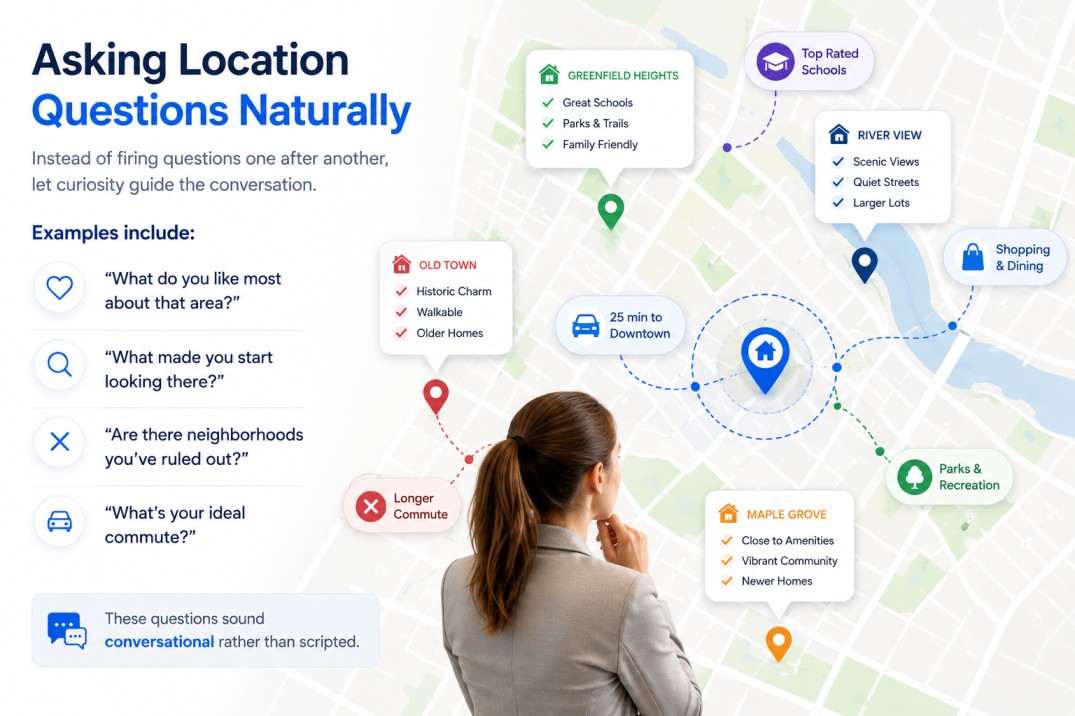
Instead of firing questions one after another, let curiosity guide the conversation.
Examples include:
"What do you like most about that area?"
"What made you start looking there?"
"Are there neighborhoods you've ruled out?"
"What's your ideal commute?"
These questions sound conversational rather than scripted.
Motivation
The Most Important Part of ALM
If Appointment creates the opportunity…
and Location provides context…
then Motivation explains why the conversation exists at all.
Without understanding motivation, every recommendation becomes a guess.
Motivation uncovers the emotional reason behind a decision.
And emotion—not logic—is what usually drives action.
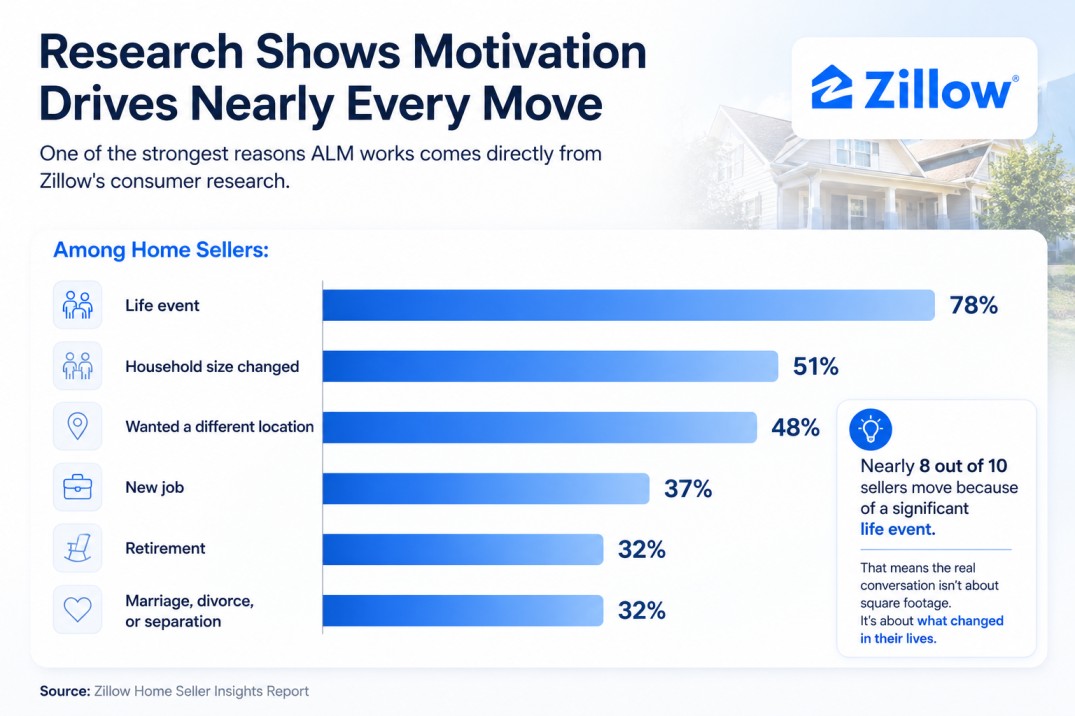
Research Shows Motivation Drives Nearly Every Move
One of the strongest reasons ALM works comes directly from Zillow's consumer research.
Among home sellers:
Reason for Moving Percentage Life event 78% Household size changed 51% Wanted a different location 48% New job 37% Retirement 32% Marriage, divorce, or separation 32%
Nearly 8 out of 10 sellers move because of a significant life event.
That means the real conversation isn't about square footage.
It's about what changed in their lives.
Finding the Emotional Story
Every buying decision contains two reasons.
Logical
Better price
More bedrooms
Lower payments
Bigger yard
Emotional
Growing family
New career
Divorce
Retirement
Desire for a fresh start
Reduced stress
Better quality of life
People explain decisions logically.
They make them emotionally.
Great salespeople understand both.
Motivation Questions That Feel Natural
Instead of asking:
"Why are you moving?"
Try:
"What changed recently that made you start looking?"
"If everything worked out perfectly, what would life look like six months from now?"
"What's most important to you during this move?"
"Why now instead of waiting another year?"
"What's driving this decision?"
Notice how these questions invite stories.
Stories reveal motivation.
Why ALM Training Works
There are countless sales methodologies.
Few are as memorable, or as practical as ALM.
Here's why.
1. Better Conversations
ALM follows the way humans naturally communicate.
Instead of jumping randomly between topics, each question builds on the previous one.
Prospects feel heard instead of interrogated.
2. Higher Appointment Rates
When people feel understood, they're naturally more willing to continue the conversation.
Appointments become a logical next step rather than something they feel pressured into accepting.
3. Less Pressure Selling
Traditional sales often revolve around persuasion.
ALM revolves around discovery.
That subtle difference dramatically changes how prospects respond.
4. Better Qualification
ALM quickly identifies:
Serious buyers
Future opportunities
Curious shoppers
Time wasters
Highly motivated prospects
Instead of spending hours with every lead, agents focus on conversations that actually matter.
Common ALM Mistakes
Even experienced agents misuse the framework.
Here are the most common mistakes.
Asking Too Many Questions Too Quickly
Nobody enjoys feeling interviewed.
Ask.
Listen.
Respond.
Then continue.
Pitching Before Understanding Motivation
Many agents start presenting solutions before understanding the actual problem.
That usually leads to objections.
Understanding always comes before recommending.
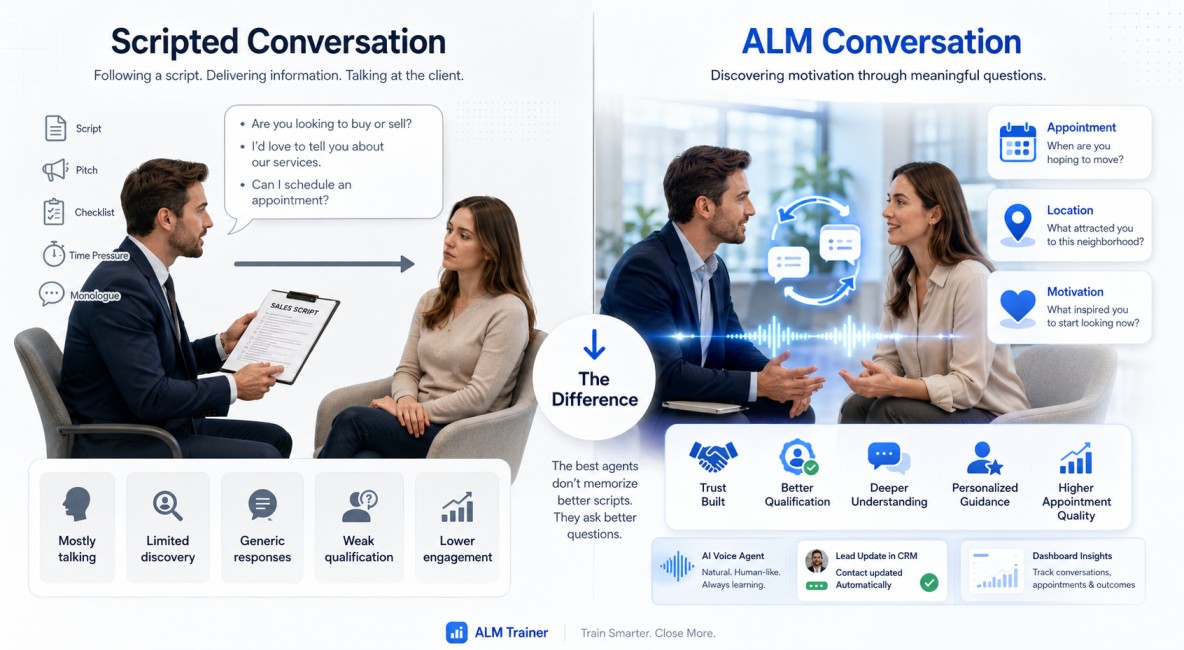
Sounding Scripted
Scripts are excellent learning tools.
They're terrible conversation partners.
Prospects instantly recognize robotic delivery.
The goal is to master the framework—not memorize sentences.
Ignoring Location
Skipping Location often leads to poor recommendations because important context is missing.
Treating Every Lead the Same
Every buyer has different motivations.
Every seller has different circumstances.
ALM is flexible because people are different.
What Experienced Agents Say
Across online real estate communities, experienced agents consistently emphasize three themes:
Discover the real reason behind the move.
Understand the prospect's timeline.
Avoid pitching before you've listened.
These discussions reinforce what ALM teaches: meaningful conversations uncover motivation first, making the rest of the sales process more effective.
While individual experiences vary, the consensus is clear agents who ask thoughtful questions tend to build stronger relationships and qualify opportunities more accurately.
How to Practice ALM
Understanding ALM is easy.
Applying it consistently is the real challenge.
Let's compare the most common ways people try to learn.
❌ Reading Scripts
Helpful for learning.
Poor for building conversational skill.
❌ Watching YouTube
Great for inspiration.
Passive learning rarely translates into confident conversations.
❌ Roleplaying Once a Week
Traditional roleplay is valuable.
But one practice session every week isn't enough.
Real conversations happen every day.
Your practice should too.
✅ Daily AI Voice Practice
The fastest improvement comes through repetition.
Modern AI voice technology allows agents to practice realistic conversations whenever they want.
Instead of memorizing lines, you practice:
Asking better questions
Handling objections
Discovering motivation
Building confidence
Thinking on your feet
Unlike static scripts, AI conversations respond differently every time, closely resembling real customer interactions.
This creates a safe environment to make mistakes, refine your approach, and improve before speaking with actual clients.
Platforms like ALMTrainer are built around this philosophy.
Rather than replacing human coaching, ALMTrainer complements it by providing realistic AI voice roleplay sessions that help agents strengthen Appointment, Location, and Motivation skills through consistent daily practice.

Frequently Asked Questions
Is ALM only for real estate?
No. While ALM became widely recognized through real estate training, its principles work in nearly every consultative sales environment.
Is ALM a script?
No.
ALM is a framework that provides structure while allowing every conversation to remain natural.
Which part is most important?
Motivation is often the strongest predictor of buying intent because it uncovers the emotional reasons behind a decision.
How long does it take to become good at ALM?
Like any communication skill, improvement depends on consistent practice. Daily conversations and regular roleplay—especially with AI—help build confidence far faster than simply reading scripts.
Final Takeaway
ALM training isn't about memorizing the perfect script—it's about learning how to ask the right questions in the right order. By focusing on Appointment, Location, and Motivation, agents move beyond simply pitching a service and instead uncover what truly matters to each client. Research from Zillow shows that buyers and sellers are often motivated by life changes, personal goals, and evolving priorities rather than just property prices or features. Understanding those motivations helps agents build trust, qualify leads more effectively, and have conversations that feel natural instead of scripted.
The ALM framework is simple to understand, but becoming skilled at using it takes consistent practice. Like any sales or communication skill, confidence comes from repetition and real conversations—not just reading scripts. Whether you're a new agent learning the fundamentals or an experienced professional looking to sharpen your approach, practicing ALM regularly helps turn knowledge into instinct, leading to stronger client relationships, more qualified appointments, and better long-term results.